Feeding Boxes, a First Feeding and Moving Day
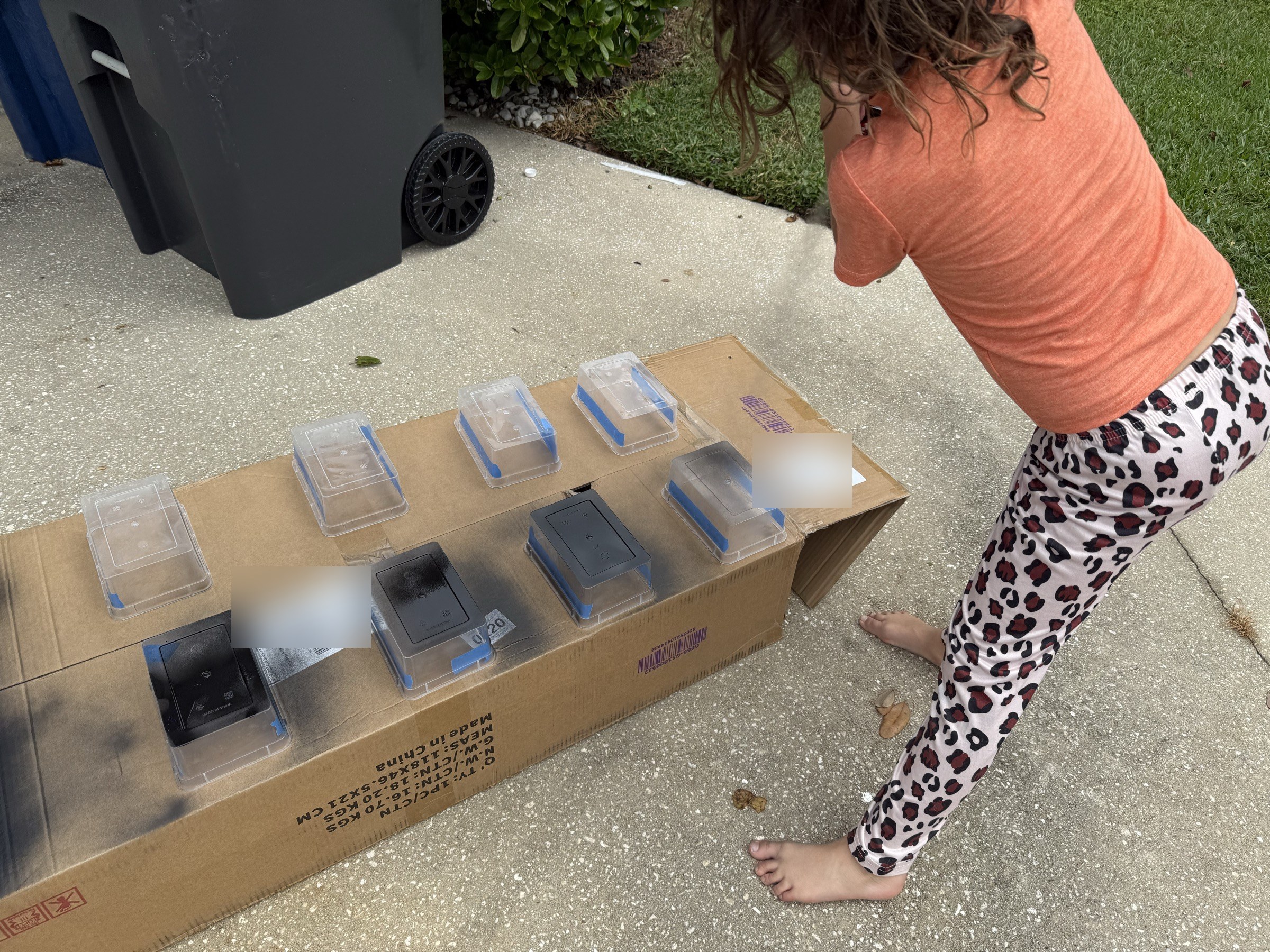
Since the last note the founders had their first feeding, the tubs got their labels, and today Rack 1 gets its sand.
Feeding boxes, with help. Our snakes don't eat in their home tubs. Each one has a small vented box of its own: at feeding time the snake goes into its box with the prey, the box sits on top of its tub, and we check it after 30 minutes. Feeding outside the tub keeps food out of the substrate and shows exactly who ate. Breathitt took on blacking out the boxes. She taped them up and spray-painted the sides black, so the snake inside has a dark, enclosed spot to eat, while the clear lids still let the cameras look in. Every box now carries the ID of the one snake that uses it, so a box sitting on a tub always says who is inside.
First feeding. On November 2 the seventeen snakes were each offered one pinky mouse, and twelve ate. Four of the five that refused were close to a shed, when sand boas often skip a meal; the fifth, CT-02, will simply be offered again. Because the boxes sit right under the cameras, we could watch the feeds and saw what a successful one looks like: the snake coils around the prey, the prey disappears, and at the check the box is empty and the snake has a bulge midbody. Those recordings are kept as examples for teaching the cameras to recognize feeding later on.
Labels for every tub. Each tub is getting:
- a top label with the snake's ID and name,
- two corner markers, black-and-white squares the camera can find, so when a tub slides out for cleaning and goes back a little differently, the camera re-fits that tub's zone on its own,
- a scan-and-go sticker on the front, whose QR code opens care logging for that snake, so a weight or a feeding is recorded on the spot.
Photos at every weigh-in. A camera now watches the weigh-in card, so each weigh-in also saves close-up photos of the snake's markings. Those photos are how we tell look-alike snakes apart.
Teaching the cameras what to look for. Sand boas spend most of their time under the sand, so the moments that matter are small: sand shifting over a snake, a head coming up. Since November 2 the server saves a short run of frames whenever the sand moves in a tub, plus random quiet moments for comparison. We label each one (head up, surfaced, moving under the sand, or nothing) to train a detector. These labels are training data, not study observations.
Controls get their own IDs. Three of the four R&R Reptiles half-siblings are our control animals. They now carry CT-01 to CT-03, and the study founders are numbered F0-01 to F0-14 with no gaps. Tiny Tom stays F0-01. The change is logged on the Methods page.
Today: sand. The tubs in Rack 1 get their substrate today: 70% washed play sand and 30% coconut coir, mixed together and leveled to 3 inches in every tub, so no tub differs from another. Then the snakes move out of the four shared quarantine tubs into tubs of their own, each one labeled with its ID.