Why This Project Exists
Breathitt’s Story
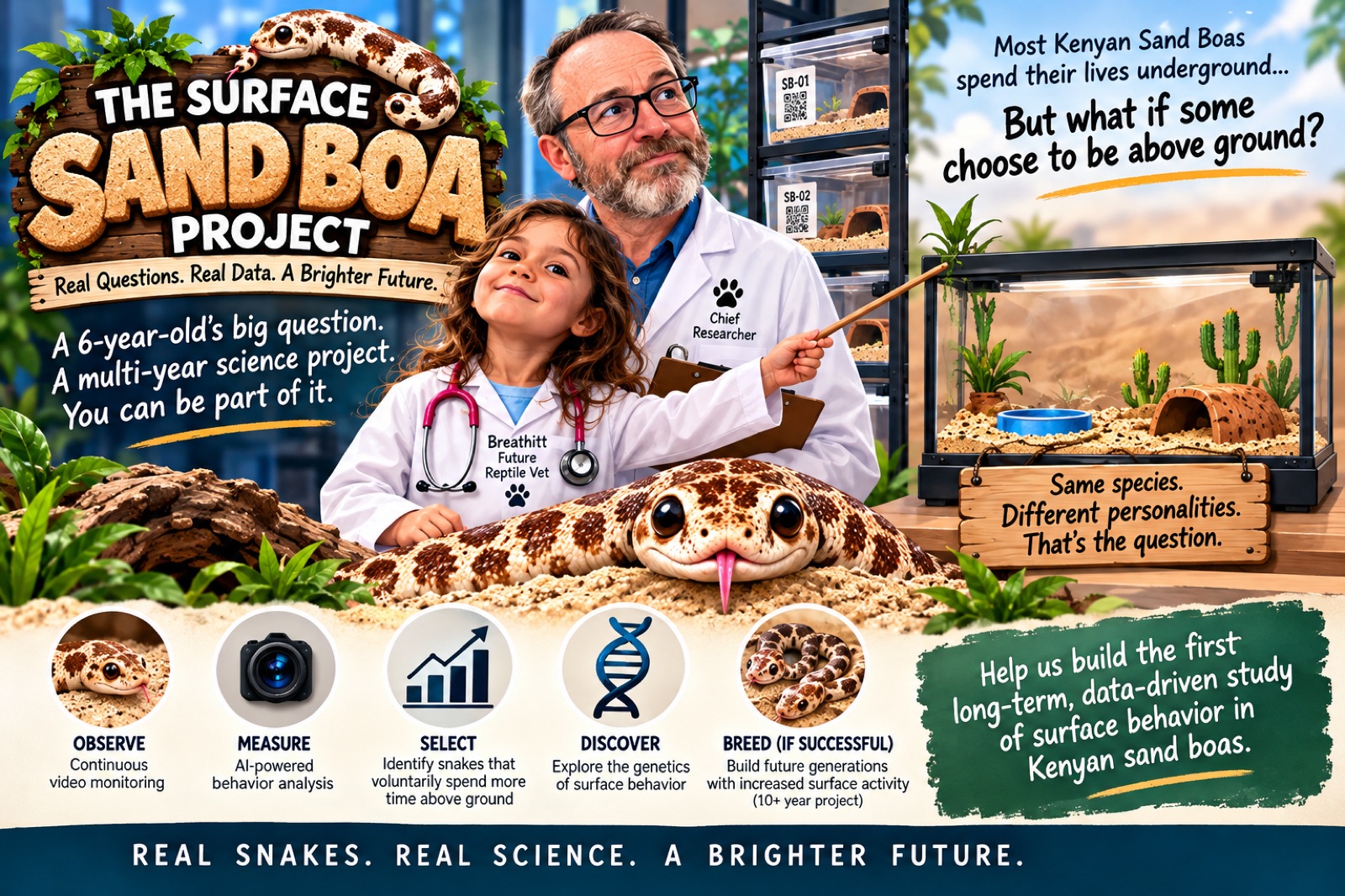
When Breathitt was six years old, she decided she wanted to become a reptile veterinarian.
She had already begun learning what it means to care for reptiles: temperatures matter, feeding matters, enclosure design matters, record keeping matters, and every animal has its own behavior.
Then she fell in love with Kenyan sand boas.
There was only one problem.
Most of the time, the snake was gone.
Not escaped. Not missing. Just underground.
Kenyan sand boas are fossorial snakes. Burrowing is what they are built to do, and we do not want to take that away from them.
But Breathitt noticed something that became the seed of the project: not every snake behaves exactly the same way.
That led to a question:
Could we selectively breed the individuals that naturally choose to stay above ground more often?
That question became The Surface Sand Boa Project.
Dad’s Job Description
Every young scientist apparently needs an assistant.
In this project, Dad’s responsibilities include building racks, printing parts, wiring cameras, creating databases, weighing snakes, cleaning enclosures, debugging software, carrying things, paying for things, and occasionally being reminded that Breathitt is the future reptile veterinarian.
The project is intentionally a father-daughter effort.
The goal is not only to learn something about Kenyan sand boa behavior. It is also to give a child years of real experience with animal care, experimental design, genetics, data, patience, responsibility, and the uncomfortable but important possibility that a hypothesis may be wrong.
Why Start This Young?
A science project does not have to begin in a university laboratory to teach scientific thinking.
Breathitt will grow up alongside this project.
If it continues for six, eight, or ten years, that means she will have participated in a long-term study from its original question through multiple generations of animals.
Someday, if she applies to veterinary school, we hope she will not simply be able to say: “I have wanted to be a reptile veterinarian since I was six.”
She will be able to show what she did about it.
What Success Means
Success is not guaranteed to mean creating a highly surface-active line.
If selective breeding produces a clear generational change, that will be fascinating.
If it produces only a weak change, that will still teach us something.
If it produces no meaningful change at all, that is still a real result.
The purpose is not to prove Breathitt right. The purpose is to find out.